
(Image credit: doc.govt.nz) In a rather heartening piece of news from New Zealand, a rare group of lizards has made its way back to the island that was once home to generations of its kind. In a media release published by New Zealand’s Department of Conservation (DOC) on November 23, 2026, it was reported that 11 niho taniwha, also known as chevron skinks, had recently returned to Aotea/Great Barrier Island after spending nearly 30 years in the care of Auckland Zoo.Their return was part of a collaborative conservation effort involving Ngāti Rehua–Ngātiwai ki Aotea Trust, DOC, Auckland Zoo and Glenfern Sanctuary. The November release followed an earlier return of ten skinks in July, bringing the total number of animals returned from the zoo group to 21.A rescue that eventually grew into a conservation effortThe three injured lizards had been taken from Aotea/Great Barrier Island to Auckland Zoo for rehabilitation between 1997 and 1999. The animals subsequently reproduced under the zoo’s care. Over the years, the group grew to comprise two of the original adults and 19 zoo-bred skinks, creating an opportunity to return the animals and their descendants to the wild.The niho taniwha is considered New Zealand’s longest lizard, growing up to 30 centimetres from its nose to the tip of its tail. The species is currently classified as ‘threatened – nationally vulnerable’ and is now found only on two islands in the Hauraki Gulf: Aotea/Great Barrier Island and Te-Hauturu-o-Toi/Little Barrier Island.Giving the skinks a place to settle inThe animals were returned to Glenfern Sanctuary, a predator-controlled sanctuary on Aotea, where the surrounding environment offers a safer setting for the threatened reptiles. The release itself involved some preparation, with the zoo and conservation teams taking steps to help the skinks become familiar with their new surroundings before they were placed in the forest.According to the Department of Conservation, the skinks had already spent several weeks acclimatising to specially made bamboo refuges at Auckland Zoo. These shelters were carefully designed to provide the animals with a place of retreat. Small radio transmitters were also attached to their tails using tape to allow researchers to track their movements after release. The skinks were then placed in the forest inside their bamboo refuges, which were left at the release sites so that the animals could return to them.This arrangement was put in place to understand how the reptiles adapt to life outside the zoo. Richard Gibson, Auckland Zoo’s Head of Animal Care and Conservation, explained that using bamboo refuges was a novel approach to tracking the animals and determining whether they continued to use the shelters over an extended period and whether these helped them adjust to life in the forest.A memorable return to the wildThere is also a cultural significance to the return of these reptiles, particularly for Ngāti Rehua, the iwi connected to Aotea. The niho taniwha is regarded as an important taonga, or treasured species, and its return represents more than a conservation milestone. For the community, it is also about restoring a connection between the species, its ancestral home and the people who have long sought its return.Rodney Ngāwaka, kaumātua and Ahi Kā of Ngāti Rehua, went on to describe the skink as a ‘true jewel of Aotea’. He emphasised that bringing the animals back was a way of reconnecting them with their whakapapa and rightful place.This wonderful return of the lizards was marked by a pōwhiri at Matariki, with iwi members and the wider community invited to participate in welcoming the animals home. Children and adults also had an opportunity to see the rare reptiles at the DOC office, while some community members helped place the bamboo shelters at selected sites within Glenfern’s forest.The story of the lizards’ conservation, however, is not complete with their return. DOC and its conservation partners are committed to conducting annual surveys of the niho taniwha at the release site, alongside dedicated efforts to raise awareness about the protection of the species.
Source link
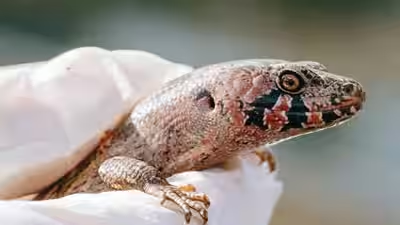
Three injured lizards were taken from a New Zealand island to Auckland Zoo in the late 1990s; nearly 30 years later, 21 skinks from that group have been returned to a predator-controlled sanctuary