
(Image courtesy: royalsocietypublishing.org) While some of us struggle to find routes without maps, a single-celled blob is out there navigating mazes without a brain, neurons or even a nervous system!Physarum polycephalum is a slime mould that is challenging what we think it takes to be intelligent. This brainless organism can explore its surroundings, identify efficient routes to food and reorganise its network to solve problems. It doesn’t think, plan or calculate in any conventional sense. Yet somehow, it gets the job done.According to a report published by Phys.org on November 25, 2026, researchers Ricard Solé and Jordi Pla-Mauri of Pompeu Fabra University in Barcelona, Spain, have developed a mathematical framework to explain how seemingly intelligent behaviour could emerge from an organism’s physical properties. They argue that having a brain is not necessarily crucial for certain forms of problem-solving, which can instead be explained through a physical principle known as the ‘principle of least action’. This principle may help explain how the slime mould reorganises its network to find efficient routes without needing a central nervous system.A single cell knows its wayFor us humans, myriads of cells have to come together to help us navigate, process information and function. But for a single-celled organism like Physarum polycephalum, things work rather differently. Resembling a spreading mass of yellowish material, it is a multinucleate amoeboid organism that behaves as one giant cell. Its body functions by forming an interconnected network of tiny tubes that transport nutrients and fluid from one region to another.But this network is constantly changing. The tubes, also known as protoplasmic strands, can become wider or narrower depending on the amount of protoplasm (fluid) flowing through them. Tubes carrying greater flows can become reinforced, while those receiving little or no flow eventually shrink. This enables the organism to adjust its physical structure according to the resources available in its immediate environment. This continuous reshaping also makes it possible for the organism to move.As explained in the original research paper, the slime mould can extend several advancing fronts to explore its environment, responding to chemical gradients released by food sources. When presented with different possible routes, it can gradually reinforce more favourable connections while retracting less useful branches.What does the principle of least action have to do with it?To understand how this happens, the researchers turned to a concept from physics called the principle of least action. In simple terms, the principle describes how physical systems evolve towards configurations that minimise a particular quantity known as action, rather than following an arbitrary sequence of movements.For the slime mould, the researchers used a mathematical formulation that considers the energy dissipated as fluid moves through its network, alongside the metabolic cost of maintaining the tubes.The framework builds on an existing mathematical model of the slime mould’s transport network, representing its interconnected tubes as a graph made up of points and connecting pathways. The researchers then used equations to examine how these connections could change as fluid moved through them.Rather than assuming that the organism consciously compares routes and chooses one, the model suggests that seemingly purposeful outcomes can emerge from the physical behaviour of the network itself.Testing different network arrangementsThe researchers applied their framework to four predefined network configurations, including a circular ring, branching tree structures and a square lattice. Each arrangement offered a different way of examining how the organism’s connections could reorganise themselves.In the circular ring configuration, two routes of unequal lengths connected the same food sources. The model showed that the longer route would eventually lose its conductance, leaving the shorter pathway intact.The researchers also examined a branching tree-shaped network, where only branches connecting food sources survived. In a square lattice, with food sources positioned at opposite corners, the model similarly favoured efficient connections between the two points. This demonstrated how the same physical principle could operate across different network structures.Does this mean the slime mould is intelligent?What the research findings primarily explore is not intelligence itself, but how problem-solving behaviour can emerge in organisms, especially those that lack a central nervous system. The researchers’ mathematical framework goes only so far as to explain how the network of tubes works and how its reshaping contributes to the mould’s movement and transport efficiency.However, this model does not explain the organism’s other demonstrated abilities, such as learning from experience or retaining information. These remain questions for separate investigations.What the research does establish is that certain behaviours that might seem like riddles for the brain to solve, involving decisions and problem-solving, could actually emerge from relatively simple physical processes. The slime mould does not need a brain to compare every possible route; its network can reorganise itself in ways that favour efficient pathways.A fascinating takeaway from this study is that it leaves us wondering how we understand intelligence-like behaviour in nature.Perhaps our own brains can sometimes limit our ability to imagine how much the natural world can accomplish without them. Sometimes, the way a living system is physically organised may be enough to help it find its way.
Source link
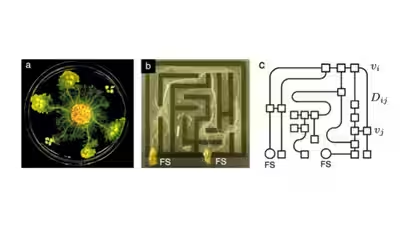
How does a brainless slime mold find the shortest path through a maze? Scientists created a mathematical model showing how four network shapes can reorganise through simple physics without any nervous system